

Situated on the south coast of England, deep within The Solent and Southampton Water, Kemp's Quay is on the east bank of the Itchen River on the periphery of Southampton. It is a small family-run marina with a pleasant feeling of bygone ‘old world’ sailing values.
Set two miles up-river of the largely protected Southampton Water the marina offers complete protection from all conditions. Safe access in all reasonable conditions, at almost all stages of the tide, night of day, is provided by The Solent and Southampton Water, one of the most well-marked and protected expanses of water in the world.


Keyfacts for Kemps Quay


Last modified
July 17th 2018 Summary
A completely protected location with safe access.Facilities


Nature


Considerations


 +44 23 8063 2323
 enquiries@kempsquay.com
Position and approaches

Expand to new tab or fullscreen
Haven position
 50° 54.797' N, 001° 22.588' W
This is the down river or southeast end of pontoon 'A' where a light is exhibited at night.



What are the key points of the approach?
The entry and the run-up thorough The Solent, Southampton Water and River Itchen are covered in
The Solent and Isle of Wight coastal description. Tidal planning will be necessary to access many of the marina's berths.
The Solent and Isle of Wight
coastal description. Tidal planning will be necessary to access many of the marina's berths.Not what you need?
Click the 'Next' and 'Previous' buttons to progress through neighbouring havens in a coastal 'clockwise' or 'anti-clockwise' sequence. Below are the ten nearest havens to Kemps Quay for your convenience.
Ten nearest havens by straight line charted distance and bearing:
- Saxon Wharf Marina - 0 nautical miles SSW
- Shamrock Quay - 0.4 nautical miles SW
- Ocean Village Marina - 1.2 nautical miles SSW
- Town Quay - 1.6 nautical miles SW
- Hythe Marina Village - 2.4 nautical miles SSW
- Marchwood Yacht Club - 2.5 nautical miles WSW
- Deacons Marina and Boatyard - 3.3 nautical miles ESE
- Elephant Boatyard - 3.3 nautical miles ESE
- Universal Marina - 3.5 nautical miles SE
- Swanwick Marina - 3.5 nautical miles SE
These havens are ordered by straight line charted distance and bearing, and can be reordered by compass direction or coastal sequence:
- Saxon Wharf Marina - 0 miles SSW
- Shamrock Quay - 0.4 miles SW
- Ocean Village Marina - 1.2 miles SSW
- Town Quay - 1.6 miles SW
- Hythe Marina Village - 2.4 miles SSW
- Marchwood Yacht Club - 2.5 miles WSW
- Deacons Marina and Boatyard - 3.3 miles ESE
- Elephant Boatyard - 3.3 miles ESE
- Universal Marina - 3.5 miles SE
- Swanwick Marina - 3.5 miles SE


How to get in?

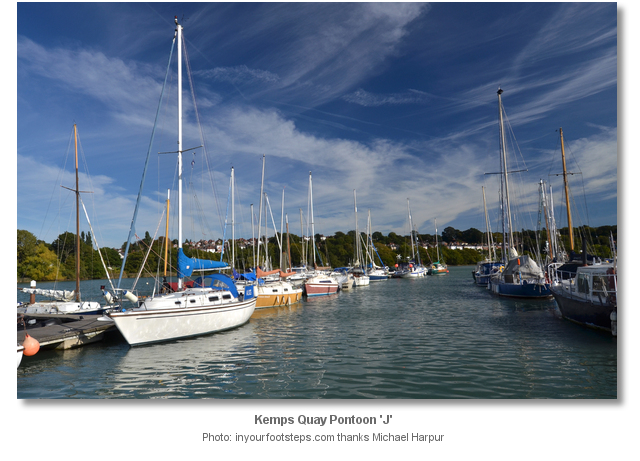
Kemps Quay is situated on the east bank of the River Itchen two miles above the river mouth at Dock Head and the junction of Southampton Waters and the River Test. It was one of the first marinas to be established in the area and has remained family owned and operated by the Kemp family for more than sixty years.
Kemp's Quay has 290 berths and can accommodate yachts from 3 to 21 metres in length with a maximum draft of 2.3 metres. The vast majority of its berths dry except for 60 deep water berths of which half are walk ashore.
Kemps Quay holds no specific visitor berths but does accommodate visiting yachts in the berths of resident holders who are away. As such it is therefore advisable to make berthing arrangements in advance by contacting the marina office by phone on P: +44 23 80 63 23 23 or E: enquiries@kempsquay.com. 24 hours’ notice is preferred but the marina office should be able to immediately advise on berth availability so it is well worth a call.
 The Solent and Isle of Wight coastal description provides approach details. Vessels navigating the six-mile length of Southampton Water should keep a listening watch for Southampton VTS, on VHF Ch 12/16, especially around the docks, and give priority to commercial traffic.
Kemps Quay’s ‘Lower Trot’ will be seen off the eastern shore’s largely drying Chessel Bay situated 200 metres northeast of Shamrock Quay where the river bends north around Millstone Point. It is a midstream pontoon opposite Millstone Point Jetty, itself made conspicuous by its large crane and exhibiting lights at night, between starboard Beacons No. 8, Fl(2)G.5s, and No. 9, Fl(4)G.10s.

With the Lower Trot abeam the marina will be seen 400 metres above on the eastern shore. It is approached between the unlit red pile mark No. 8 and the lit green beacon No. 9, Fl(4)G.10s, above the trot. After these marks the River Itchen bends westward around Saxon Wharf close northwest of Millstone Point. Kemps Quay lies opposite and is accessed around the head of Saxon Wharf’s jetty.
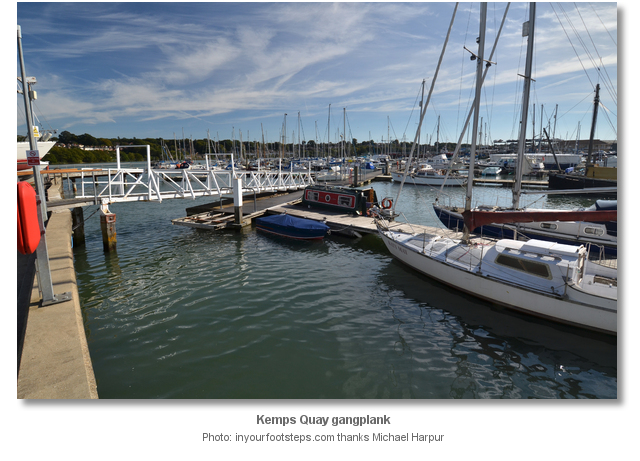
 Kemps Quay has 30 deep water berths on the outside of its ‘A’ pontoon that are non-tidal and afloat at all times with about 2 metres. The midstream ‘lower trot’ has a further 30 berths where 2.3 metres will be found.
 English Nature has made the east bank of the River Itchen a nature reserve which includes Kemps Quay. As such dredging is not permitted and the remainder of its berths are semi-tidal with their coverage varying from a drying height of 1.3 to 2.2 metres according to their proximity to the shore. All the semi-tidal berths dry to soft mud that provides a stable berth for most craft when the tide is away. These may only be entered during the top half of the tide.
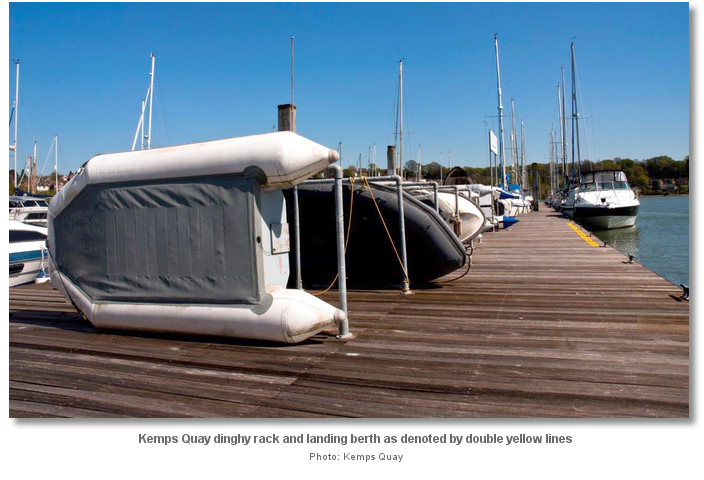
A landing/loading berth, denoted by double yellow lines, is afloat at all times. It is available for boat owners who cannot leave or land within the tide window.
Why visit here?
The origins of Kemps Quay and its name go back to the remarkable Robert Kemp Senior. Born in 1880 Robert Kemp was to start a maritime family business that would span three generations and continues to this day.Raised on the small Island of Guersay, in the Orkneys, Robert Kemp Senior had to sail to the mainland each day to attend school. Stern Victorian discipline and a relentless focus on punctuality taught him to sail boats fast and in all conditions. This developed an innate skill that was to set his course in life. After school he trained as a Yacht Master, Engineer and in 1916 he became a Naval Architect. His success as a sailing skipper brought him to the helm of his own maritime business at the very heart of English sailing in Southampton. Kemps Shipyard Limited commenced as a Yacht Broker in a shop at the bottom of Southampton High Street, near the port, in 1912. Soon he had interests in boatyards such as Ferry Yard in Woolston and Emsworth Shipyard. He opened his own boatyard in Hythe in 1922 focused on general boat construction and repair where he was to fair very well converting ex-naval craft into private luxury motor boats. Alongside this business success Robert Kemp Senior was a legendary sailor. He helmed many of the majestic J’s of the time including the King’s own yacht ‘Britannia’ and Thomas Lipton’s yacht ‘Shamrock’.
His son Robert Kemp Jnr., the current MD, was born in 1952 and like his father before him established himself in the engineering conglomerates of the Midlands. A serious injury his father received in the 1978 ‘Cowes-Torquay’ powerboat race brought Robert ‘Minor’ south to help in the family business. He was met by a dramatically changing marine industry that was facing severe headwinds. The ‘1970’s oil price shock’ sent the price of resin skyrocketing and the government of the time had simultaneously introduced 20% VAT on all leisure craft. ‘Senior Marine’ gradually wound down and ‘Glascade GRP’ pivoted towards commercial fibreglass products for the construction industry. This became very successful and Robert Jnr. sold the company along with Kemps Masts, as going concerns. The money was reinvested into Kemps Quay, then known as Kemps Shipyard, where major reclamation work was undertaken, a quay wall was built and the marina was enlarged and improved. The company Kemps Shipyard Ltd. marked its centenary as part of the group that runs the marina, the rental of industrial units, brokerage of new and second-hand yachts, and small repairs on the slipway.

From a sailing perspective the deep history of more than 100 years of single family ownership, of serving the sailing community, providing local employment and the deep connection to sailing itself provide Kemps Quay with a special atmosphere. Set alongside the modern chain complexes of The Solent Kemp’s Quay has an agreeable, 'no-frills’, true ‘old world sailing’ feel that is affordable and very endearing.
Like all the marinas on the River Itchen, with the exception of Ocean Village, Kemps Quay is a taxi ride to downtown Southampton. The added disadvantage Kemps Quay has is that it is on the wrong side of the Itchen for the city centre of Southampton. However, unlike Shamrock Quay and Saxon Wharf, it has the advantage of having Bitterne Station little over 5 minutes’ walk away. The station links direct to the centre of the town, and the adjacent Northam Road, a main arterial road downtown, provides a regular convoy of buses to choose from.
What facilities are available?
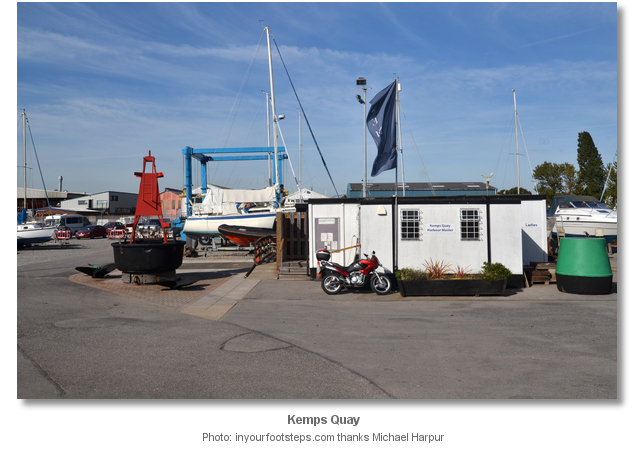
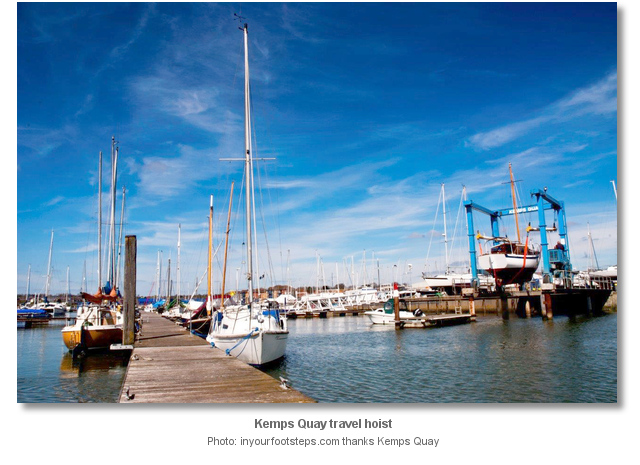
Kemps Quay pontoons all provide water but only a handful of selected points have electricity. Domestic requirements such as showers and toilets are above the bridgehead. Facilities for garbage disposal, and waste oil can be disposed of ashore by arrangement with the marina office. Fuel fill by cans from the local garage. Alongside diesel fuel, not petrol, can however be obtained at Itchen Marine at American Wharf, close south, or within Hythe Marina Village in Southampton Water.Kemps Quay has a travel hoist with an 8 ton capacity, and power washing and hard standing for up to 80 craft on a 'first come' basis. When adjacent Saxon Wharf and Shamrock Quay are added to the resource pool every repair facility a vessel could require; marine engineers, riggers, sailmakers, electronic and electrical experts are all within the immediate area. A local garage sells essentials and Bitterne, a five-minute bus ride, has a choice of supermarkets and many other outlets.
Kemps Quay is a taxi ride to downtown Southampton but Bitterne Station little over 5 minutes’ walk away links direct to the centre of the town. The adjacent Northam Road, a main arterial road downtown, also has a choice of buses to the city centre. Southampton, being a major city and commercial port, has excellent transport connections. Regular car ferries, or fast catamarans, ply their way to Cowes, Isle of Wight, and these are a short taxi ride away. Mainline trains are available to London Waterloo, 70 minutes, Poole, Weymouth, Portsmouth and Brighton. These are complemented by a wide variety of local and regional bus services. Southampton International Airport with internal and continental flights is a 20 minute taxi ride in free flowing traffic. The M27 motorway connecting to the M3 and A3 is a 20 minutes’ drive.
Any security concerns?
Single point security gate access is achieved to all berths from the ample car park.With thanks to:
Sarah Walker Kemps Quay. Photography with thanks to Michael Harpur and Kemps Quay.






About Kemps Quay
The origins of Kemps Quay and its name go back to the remarkable Robert Kemp Senior. Born in 1880 Robert Kemp was to start a maritime family business that would span three generations and continues to this day.
Raised on the small Island of Guersay, in the Orkneys, Robert Kemp Senior had to sail to the mainland each day to attend school. Stern Victorian discipline and a relentless focus on punctuality taught him to sail boats fast and in all conditions. This developed an innate skill that was to set his course in life. After school he trained as a Yacht Master, Engineer and in 1916 he became a Naval Architect. His success as a sailing skipper brought him to the helm of his own maritime business at the very heart of English sailing in Southampton. Kemps Shipyard Limited commenced as a Yacht Broker in a shop at the bottom of Southampton High Street, near the port, in 1912. Soon he had interests in boatyards such as Ferry Yard in Woolston and Emsworth Shipyard. He opened his own boatyard in Hythe in 1922 focused on general boat construction and repair where he was to fair very well converting ex-naval craft into private luxury motor boats. Alongside this business success Robert Kemp Senior was a legendary sailor. He helmed many of the majestic J’s of the time including the King’s own yacht ‘Britannia’ and Thomas Lipton’s yacht ‘Shamrock’.
His son Robert Kemp Jnr., the current MD, was born in 1952 and like his father before him established himself in the engineering conglomerates of the Midlands. A serious injury his father received in the 1978 ‘Cowes-Torquay’ powerboat race brought Robert ‘Minor’ south to help in the family business. He was met by a dramatically changing marine industry that was facing severe headwinds. The ‘1970’s oil price shock’ sent the price of resin skyrocketing and the government of the time had simultaneously introduced 20% VAT on all leisure craft. ‘Senior Marine’ gradually wound down and ‘Glascade GRP’ pivoted towards commercial fibreglass products for the construction industry. This became very successful and Robert Jnr. sold the company along with Kemps Masts, as going concerns. The money was reinvested into Kemps Quay, then known as Kemps Shipyard, where major reclamation work was undertaken, a quay wall was built and the marina was enlarged and improved. The company Kemps Shipyard Ltd. marked its centenary as part of the group that runs the marina, the rental of industrial units, brokerage of new and second-hand yachts, and small repairs on the slipway.
From a sailing perspective the deep history of more than 100 years of single family ownership, of serving the sailing community, providing local employment and the deep connection to sailing itself provide Kemps Quay with a special atmosphere. Set alongside the modern chain complexes of The Solent Kemp’s Quay has an agreeable, 'no-frills’, true ‘old world sailing’ feel that is affordable and very endearing.
Like all the marinas on the River Itchen, with the exception of Ocean Village, Kemps Quay is a taxi ride to downtown Southampton. The added disadvantage Kemps Quay has is that it is on the wrong side of the Itchen for the city centre of Southampton. However, unlike Shamrock Quay and Saxon Wharf, it has the advantage of having Bitterne Station little over 5 minutes’ walk away. The station links direct to the centre of the town, and the adjacent Northam Road, a main arterial road downtown, provides a regular convoy of buses to choose from.
Other options in this area
Click the 'Next' and 'Previous' buttons to progress through neighbouring havens in a coastal 'clockwise' or 'anti-clockwise' sequence. Alternatively here are the ten nearest havens available in picture view:
Coastal clockwise:
Saxon Wharf Marina - 0 miles SSWShamrock Quay - 0.2 miles SW
Ocean Village Marina - 0.7 miles SSW
Town Quay - 1 miles SW
Eling - 2.5 miles W
Coastal anti-clockwise:
Netley - 2.2 miles SSEHamble Point Marina - 2.8 miles SE
Port Hamble Marina - 2.5 miles SE
Mercury Yacht Harbour - 2.2 miles SE
Elephant Boatyard - 2.1 miles ESE
Navigational pictures
These additional images feature in the 'How to get in' section of our detailed view for Kemps Quay.


| Detail view | Off |
| Picture view | On |
 A photograph is worth a thousand words. We are always looking for bright sunny photographs that show this haven and its identifiable features at its best. If you have some images that we could use please upload them here. All we need to know is how you would like to be credited for your work and a brief description of the image if it is not readily apparent. If you would like us to add a hyperlink from the image that goes back to your site please include the desired link and we will be delighted to that for you.
Add your review or comment:
Please log in to leave a review of this haven.
Please note eOceanic makes no guarantee of the validity of this information, we have not visited this haven and do not have first-hand experience to qualify the data. Although the contributors are vetted by peer review as practised authorities, they are in no way, whatsoever, responsible for the accuracy of their contributions. It is essential that you thoroughly check the accuracy and suitability for your vessel of any waypoints offered in any context plus the precision of your GPS. Any data provided on this page is entirely used at your own risk and you must read our legal page if you view data on this site. Free to use sea charts courtesy of Navionics.