
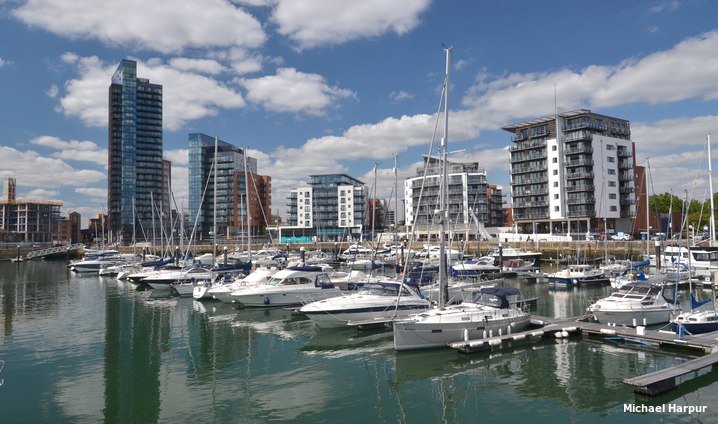
Enclosed and located within The Solent and at the head of Southampton Water the marina offers complete protection. It can be safely accessed night or day, at any state of the tide and in all reasonable conditions.


Keyfacts for Ocean Village Marina
Facilities


Nature


Considerations


Protected sectors

Approaches

Shelter
Last modified
July 17th 2018 Summary
A completely protected location with safe access.Facilities
Nature
Considerations
 +44 8022 9385
  oceanvillage@mdlmarinas.co.uk
  mdlmarinas.co.uk/mdl-ocean-village-marina
  Ch.80/M [Ocean Village Marina]
 Position and approaches

Expand to new tab or fullscreen
Haven position
 50° 53.721' N, 001° 23.344' W
This is the position of the Dock Office on the north side of the main entrance.



What are the key points of the approach?
The entry and the run-up thorough The Solent, Southampton Water and River Itchen are covered in
The Solent and Isle of Wight coastal description.
The Solent and Isle of Wight
coastal description. Not what you need?
Click the 'Next' and 'Previous' buttons to progress through neighbouring havens in a coastal 'clockwise' or 'anti-clockwise' sequence. Below are the ten nearest havens to Ocean Village Marina for your convenience.
Ten nearest havens by straight line charted distance and bearing:
- Town Quay - 0.6 nautical miles W
- Shamrock Quay - 0.8 nautical miles NNE
- Saxon Wharf Marina - 1.1 nautical miles NNE
- Kemps Quay - 1.2 nautical miles NNE
- Hythe Marina Village - 1.2 nautical miles SSW
- Marchwood Yacht Club - 2 nautical miles WNW
- Netley - 2.9 nautical miles SE
- Universal Marina - 3.3 nautical miles ESE
- Elephant Boatyard - 3.3 nautical miles ESE
- Deacons Marina and Boatyard - 3.3 nautical miles ESE
These havens are ordered by straight line charted distance and bearing, and can be reordered by compass direction or coastal sequence:
- Town Quay - 0.6 miles W
- Shamrock Quay - 0.8 miles NNE
- Saxon Wharf Marina - 1.1 miles NNE
- Kemps Quay - 1.2 miles NNE
- Hythe Marina Village - 1.2 miles SSW
- Marchwood Yacht Club - 2 miles WNW
- Netley - 2.9 miles SE
- Universal Marina - 3.3 miles ESE
- Elephant Boatyard - 3.3 miles ESE
- Deacons Marina and Boatyard - 3.3 miles ESE

Chart

How to get in?
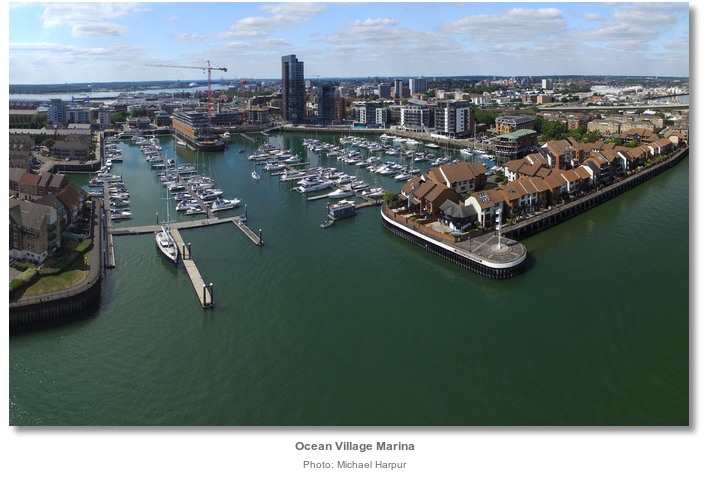
Ocean Village Marina lies at the northernmost point of Southampton Water, ¾ of a mile above the mouth of the River Itchen at Dock Head. It is a mixed-use waterfront development that includes residential, business and a leisure development featuring restaurants, shops, and cinemas etc centred on the marina. It was formally the site of Southampton's first working docks until its 1980s redevelopment.

Ocean Village Marina holds no specific visitor berths and accommodates visiting yachts on the berths of resident holders that are away. It is therefore advisable to make berthing arrangements in advance by contacting the reception on VHF Channel 80/M or P: +44 23 8022 9385.
 The Solent and Isle of Wight coastal description provides approach details. Vessels navigating the six-mile length of Southampton Water should keep a listening watch for Southampton VTS, on VHF Ch 12/16, especially around the docks, and give priority to commercial traffic.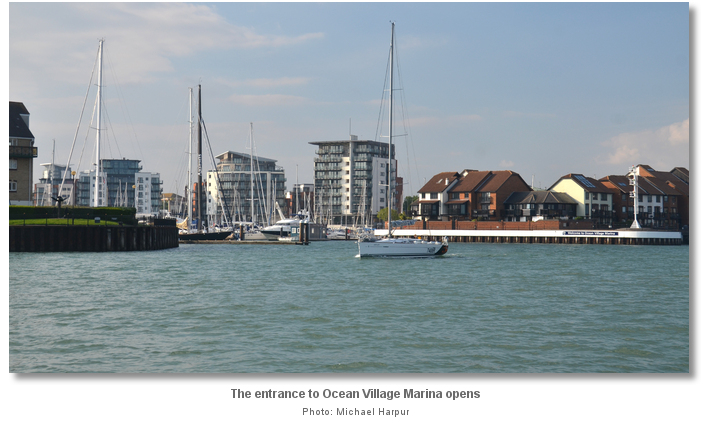
Ocean Village Marina lies on the west side of the River Itchen ¾ of a mile above the river mouth and ¼ of a mile below the Itchen Bridge. The marina’s entrance is easily picked out by the 120-metre opening it forms in the housing on either side. It has a large sign just above the pilings on the north side of the entrance close to a white traffic signal station. The marina is entered along the north side of the opening passing close south of the Dock Office on ‘A’ Pontoon.
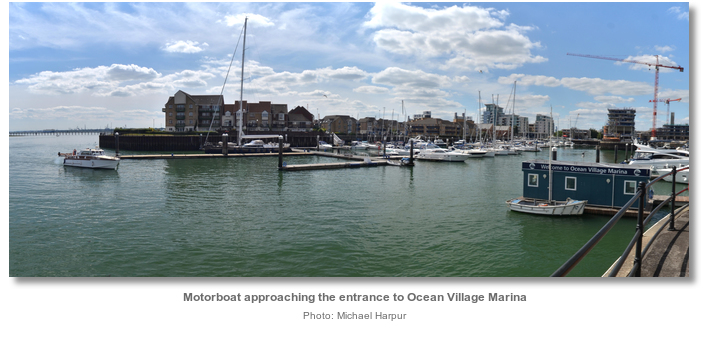 Berth as directed by the marina office.
Why visit here?
Ocean Village Marina is owned and operated by Marina Development Limited (MDL) based in Hamble Hampshire. The company owns and manages eighteen coastal marinas and boatyards in England including Hythe Marina Village, passed near the head of Southampton Water, along with those of Shamrock Quay and Saxon Wharf marinas located further upriver. It has other facilities in France, Italy and Spain and the company provides its berth holders with freedom to roam between their extensive ranges of facilities when space is available.

The inter-war years saw the filling-in of Western Bay after which the fortunes of the Old, or eastern docks ebbed and flowed. ‘Outer Dock’ showed its age in the 1960s when Southampton focused on the new 'drive-on, drive-off' continental ferry services. To meet this new requirement the dock had to be adapted and enlarged to accommodate the large cross Channel ferries and their new loading patterns. In 1963 the entrance to the ‘Outer Dock’ was widened and the ‘Inner Dock’, the oldest dry dock that by then was too small for the latest ships, was filled in to become a car park for the roll-on, roll-off continental ferries. By 1967 ‘Outer Dock’ had been significantly enlarged featuring 9 berths, and had an additional two new terminals added and a passenger viewing area. It was rechristened Princess Alexandra Dock after Princess Alexandra, The Honourable Lady Ogilvy the youngest granddaughter of King George V and Queen Mary, who personally opened it to great fanfare in July 1967.
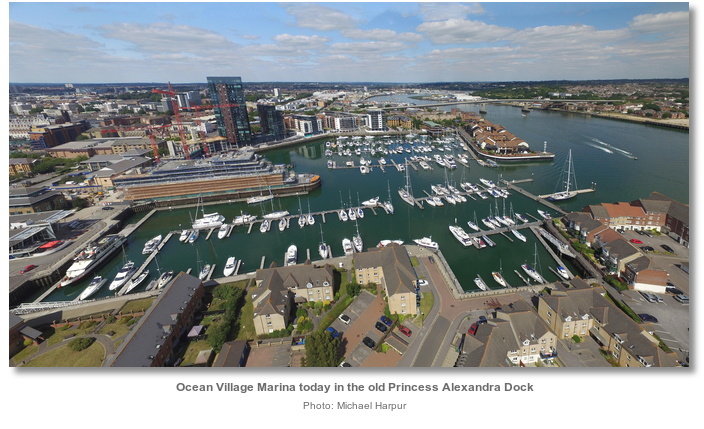
The seminal years for Princess Alexandra Dock came between 1973 and 1975. At this time it had 58 crossings a week to locations as far afield as France, Morocco, Portugal and Spain. Yet as little as a decade later Southampton’s ferry services had all but ceased. Many headwinds caused this abrupt transition. The growth of air travel, the opening of the Channel Tunnel, the loss of duty-free sales, the decline of freight were amongst many other reasons. By 1984 all of Princess Alexandra Dock’s ferry services had closed and what remained transferred to the Western Docks for a short time. When the Royal Navy’s needs reduced, the docks of the more competitively positioned Portsmouth took Southampton’s remaining ferry traffic and only ‘Ocean Dock’ continued to be used by Cunard, as it is today.
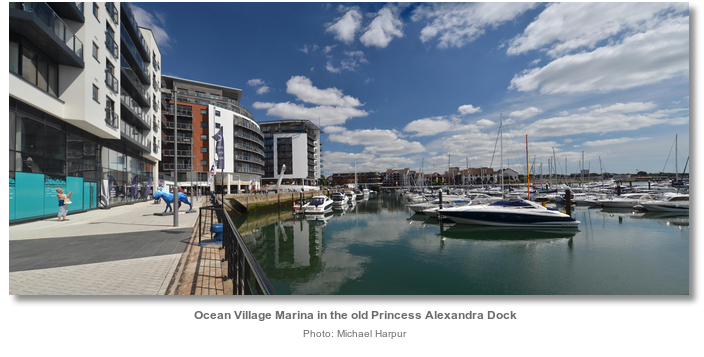
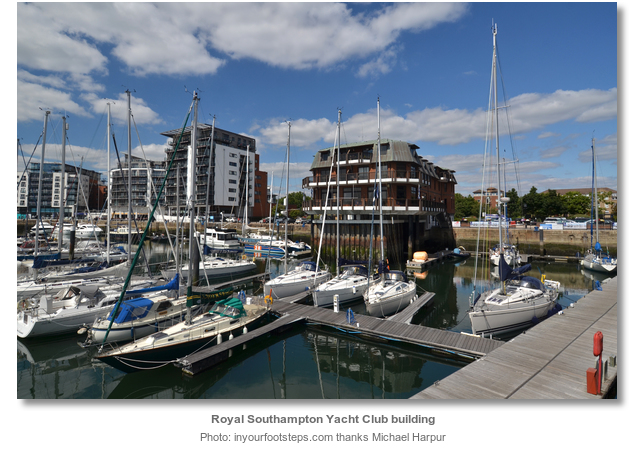
Then the vacated 75 acres of Princess Alexandra Dock was sold by Associated British Ports, to become the Ocean Village. Ocean Village was one of a series of redevelopments of rundown dockland areas in Britain's leading ports that was part of the wider global trend of waterfront transformation at the time. The development transformed the old dock into shops, offices, residential accommodation, leisure facilities and a central marina in 1986. On two massively reinforced structures that could not easily be demolished, Royal Southampton Yacht Club took the opportunity to build their second clubhouse in a spectacular commanding position overlooking the marina.

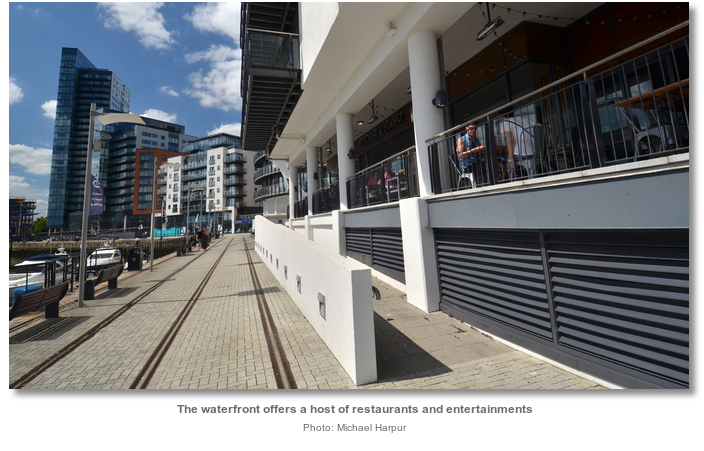
The commercial and leisure core of Ocean Village's current facilities include cafes, wine bars and restaurants on the complex. It also includes two cinemas; Harbour Lights, designed to resemble an ocean liner, that features indie or arthouse movies and the mainstream Cineworld multiplex.
With all this surrounding activity Ocean Village is not a destination for those looking for a quiet location. Surrounded by an over-landscaped space full of modern impersonal low rise office blocks and domestic accommodation three to five stories high, many with glazed facades, it is not immediately prepossessing to the eye. Yet there are very pleasant walks around the marina with views overlooking its tranquil waters and the range of boats inhabiting the dock. Likewise the city of Southampton, covered in Town Quay, is just a short stroll away.
From a sailing point of view Ocean Village is a perfectly sheltered all weather location, accessible 24 hours a day, at the very heart of the city of Southampton. It is also home to one of Royal Southampton Yacht Club’s two clubhouses, the other being at Gins Farm covered separately. Although a member’s yacht club, it offers berth holders and visitors a warm and friendly welcome. The deep water heritage of the old dock also allows the marina to accommodate large yachts and Tall Ships. It is renowned for hosting major yacht races; the start of seven, and finish of four, Whitbread, now Volvo, round-the-world races took place at Southampton between 1977 and 2001, and the Global Challenge started from the port in 1992, 1996 and 2000.
What facilities are available?
All the pontoons provide power and water. Domestic requirements such as showers, toilets, launderette facilities up to and including WiFi can be found throughout the marina area. Facilities for garbage disposal, and waste oil can be disposed of ashore close to the marina office.The complex has a choice of bars, cafés and restaurants immediately ashore that includes Banana Wharf, Maritimo Lounge, Bacaro, Steak of the Art, Pitcher & Piano, and Chiquito Mexican. Royal Southampton Yacht Club also welcomes members from affiliated clubs and accepts visitors. It has a bar and serves evening meals from Wednesday through Saturday. Provisions can be obtained from a good sized Tesco Metro Express within the complex. Southampton City, a short bus or taxi ride, has a choice of excellent large scale supermarkets and shopping centres for more concerted provisioning.
Ocean Village does not provide alongside diesel fuel and this, not petrol, can however be obtained at Itchen Marine at American Wharf, about 300 metres above the Itchen Bridge, or within Hythe Marina Village in Southampton Water. Likewise it does not have repair facilities but its upriver sister marinas of Shamrock Quay and Saxon Wharf have every repair facility a vessel could require; marine engineers, riggers, sailmakers, electronic and electrical experts are all immediately ashore. They have travel hoists that can lift vessels weighing up to 200 tons and ample hard standing ashore.
The major city and commercial port of Southampton has excellent transport connections. Regular car ferries, or fast catamarans, ply their way to Cowes, Isle of Wight, and these are a short taxi ride away. Mainline trains are available to London Waterloo, 70 minutes, Poole, Weymouth, Portsmouth and Brighton. These are complemented by a wide variety of local and regional bus services. Southampton International Airport with internal and continental flights is a 30 minute’ taxi ride in free flowing traffic. The M27 motorway connecting to the M3 and A3 is a 20 minute’ drive.
Any security concerns?
The marina is highly attentive to security. Gates are coded and a 24 hour security system is maintained with CCTV.With thanks to:
Bertie Marsh Ocean Village Marina. Photography with thanks to Michael Harpur.




MDL introduction to Ocean Village Marina


 A photograph is worth a thousand words. We are always looking for bright sunny photographs that show this haven and its identifiable features at its best. If you have some images that we could use please upload them here. All we need to know is how you would like to be credited for your work and a brief description of the image if it is not readily apparent. If you would like us to add a hyperlink from the image that goes back to your site please include the desired link and we will be delighted to that for you.
Add your review or comment:
Please log in to leave a review of this haven.
Please note eOceanic makes no guarantee of the validity of this information, we have not visited this haven and do not have first-hand experience to qualify the data. Although the contributors are vetted by peer review as practised authorities, they are in no way, whatsoever, responsible for the accuracy of their contributions. It is essential that you thoroughly check the accuracy and suitability for your vessel of any waypoints offered in any context plus the precision of your GPS. Any data provided on this page is entirely used at your own risk and you must read our legal page if you view data on this site. Free to use sea charts courtesy of Navionics.