

The anchorage is only suitable in settled or offshore conditions. Access is straightforward as although there are some outlying rocks around the headland the bay is clean and easily addressed in daylight.

Keyfacts for Portbraddan
Facilities


Nature


Considerations
Protected sectors

Approaches

Shelter

Last modified
February 7th 2023 Summary
A tolerable location with straightforward access.Facilities
Nature
Considerations
Position and approaches

Expand to new tab or fullscreen
Haven position
 55° 14.095' N, 006° 24.593' W
This is about 300 metres offshore of the southwest end and on the 2-metre contour of White Park Bay.
What is the initial fix?
The following Portbradden Initial Fix will set up a final approach:
 55° 14.253' N, 006° 24.464' W



What are the key points of the approach?
Offshore details are available in northeast Ireland’s Coastal Overview for Malin Head to Strangford Lough  .
.
.- Keep off Gin Point as it has a northern spur of Otter Rock and outliers to the east.
- Keep out of the eastern side of the bay which is foul a ⅓ of a mile from the bay’s eastern shoreline.
- Track into the southwest corner from the northwest.
Not what you need?
Click the 'Next' and 'Previous' buttons to progress through neighbouring havens in a coastal 'clockwise' or 'anti-clockwise' sequence. Below are the ten nearest havens to Portbraddan for your convenience.
Ten nearest havens by straight line charted distance and bearing:
- Ballintoy Harbour - 1.6 nautical miles ENE
- Portballintrae - 4.8 nautical miles WSW
- Ballycastle - 6.1 nautical miles ESE
- Church Bay - 8.1 nautical miles ENE
- Portrush Harbour - 8.7 nautical miles WSW
- Murlough Bay - 10.3 nautical miles E
- Coleraine - 10.6 nautical miles WSW
- Seatons Marina - 10.9 nautical miles WSW
- Torr Head - 12.2 nautical miles ESE
- The Lower River Bann - 12.3 nautical miles WSW
These havens are ordered by straight line charted distance and bearing, and can be reordered by compass direction or coastal sequence:
- Ballintoy Harbour - 1.6 miles ENE
- Portballintrae - 4.8 miles WSW
- Ballycastle - 6.1 miles ESE
- Church Bay - 8.1 miles ENE
- Portrush Harbour - 8.7 miles WSW
- Murlough Bay - 10.3 miles E
- Coleraine - 10.6 miles WSW
- Seatons Marina - 10.9 miles WSW
- Torr Head - 12.2 miles ESE
- The Lower River Bann - 12.3 miles WSW

Chart

What's the story here?
 Portbradden
Image: Kenneth Allen via CC BY 2.0
Portbraddan is nestled in a small gorge at the western end of White Park Bay which provides the small picturesque hamlet with sheltered from the prevailing westerlies. It was once a Salmon fishery and retains a small slip which makes for a convenient landing place as the bay is subject to a swell and there usually is surf on the beach.
Vessels can anchor over good holding in White Park Bay in settled or offshore conditions.
How to get in?
 The western part of White Park Bay
Image: Tourism NI
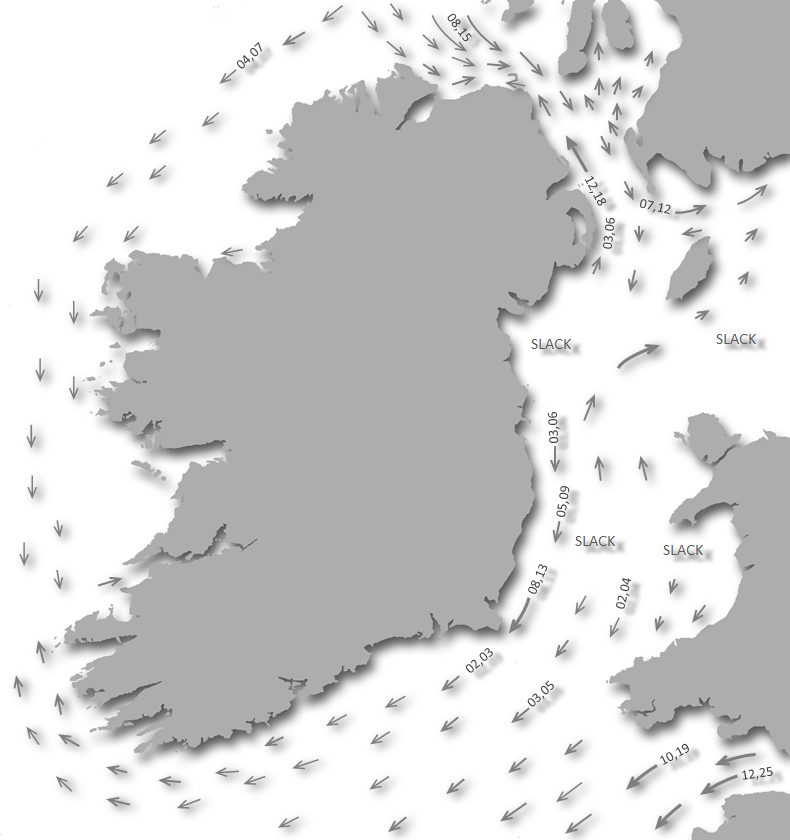
 Offshore details are available in northeast Ireland’s coastal overview for Malin Head to Strangford Lough . The details provided for Church Bay
  on Rathlin Island and its tidal data provide approach details for this corner of Ireland. The direction and velocity of the tide should be the central feature of any navigation planning in this area. White Park Bay is situated 1½ miles to the west of Sheep Island and 2 miles from Bengore Head. It forms a white arc between the headlands of Gin Point and Ballintoy.
  The eastern end of White Park Bay is foul
Image: Tourism NI
The eastern end of the bay is foul out to ¾ of a mile from Ballintoy Point. This end of the bay has several covered and awash rocks that reach out a ⅓ of a mile from the shoreline, further out than the visible straggler Long Gilbert. Keeping outside the 10 metres contour on the east side of the bay clears all dangers.
Vessels approaching from the west should stand well off the western Gid Point as the rocky tongue of rock terminating with Otter Rock extends a ½ mile north from the headland.
 The western half of the bay is clean shoaling gradually to the shore
Image: Tourism NI
The western half of the bay is clean with 20 metres a ½ a mile out and soundings, over a sandy bottom, decreasing gradually to the shore.
 The approaches to the western half of White Park Bay
Image: Tourism NI
 From the Initial Fix proceed towards the southwest corner. Depths decrease gradually towards the shore.
  The southwest corner of White Park Bay
Image: Tourism NI
Anchor over sand with excellent holding according to draught and conditions.Why visit here?
Portbraddan, or Portbraddon, takes its name from the Irish 'Port Bradán', which means 'port of the salmon'. This dates back to its ancient origins as a salmon station along with Carrickarede and Larry Bane all of which have extensively fished Atlantic Salmon here since 1620.right).jpg) Portbradden with the old quay for landing the salmon )right)
Portbradden with the old quay for landing the salmon )right)Image: Alistair Cunningham via CC BY-SA 2.0
The salmon fishery was a key industry for this coast and a way of life for its inhabitants for many centuries. These waters are home to Atlantic Salmon, the largest breed of salmon in the world. They lay their eggs in freshwater rivers and, when old enough, traveled hundreds of miles to reach cool saltwater. These stations caught the migrating salmon as they made their way back to their spawning grounds in the River Bann. But by the 20th century, the pressure of fishing and river pollution caused the salmon population to precipitously decline. In bygone days the fisherman would regularly catch up to 300 fish in one trip, but in the final seasons that persisted into the 1960s, fishermen would be lucky to catch 250 fish in the entire period from Spring to Autumn. So the ancient salmon fishing station of Portbraddon came to an end although it still has an operational slipway.
 The broad sands of White Park Bay
Image: Tourism NI
Inshore of the hamlet is the spectacular sandy beach of White Park Bay that forms a white arc between the headlands of Gin Point and Ballintoy. It was anciently called 'Murbholg', meaning 'sea-bag', from 'muir', 'sea', and 'bolg' 'a bag'. It is dominated by chalk and is noted for its archaeological sites, including a Stone Age settlement where excavations revealed food remains such as the bones of the now-extinct great auk. Exposed beds of soft lias clay contain fossils, such as the gryphaea 'Devil’s toenails', an ancient bivalve shell. Major geological faulting created the tilted rock stacks on the approach to Ballintoy Harbour.
 The east end of White Park Bay
Image: Michael Harpur
The 2km long sandy sweep of White Park Bay was also a site of much industry from the 18th century to the 1930s. Then it was lined with kelp burners and thick white smoke filled the air. These small kilns burned seaweed that had been collected and dried on its wide sandy beach. The large proportion of iodine that kelp contains could then be extracted from the ash. The ash was used initially in the production of glass, and it was also mixed with animal fats, was then widely used as an antiseptic and ointment for cuts and sores.
 White Park Bay sunbathers
Image: Tourism NI
In the latter half of the 20th century, Portbraddan was noted for having the smallest Church in Ireland, St Gobban's. This was a slate-roofed little church, just 3.5 metres by a little under 2 metres tucked in at the south end of the Millhouse. In the early 1960s, a retired Reverand bought the house and land nestled into the small nook and taught classics and divinity from the building. In 1965 he discovered the property was one of the Christian sites established in the area by St Gobban, who lived from 560-639. This is very much the case as St Gobban's ancient church of Templastragh was built a kilometre from Portbraddon on the cliff top towards Dunseverick Harbour the ruins of a tiny chapel, St Lasseragh’s, stands on the cliff above. He and his students then came up with the novel idea of converting a small outbuilding that served as a calf byre into a chapel. So the calf shed originally built in the 1950s became St Gobban's chapel.
 The diminutive St Gobban's church before it was taken down
Image: © Mark Murry
Afterwards, the building was mistakenly listed by the government without proper research being carried out and only when the facts emerged, much later it had to be de-listed. But in the intervening time, thousands of visitors had flocked to the smallest church in Ireland every year. Many were local women who came back home to Northern Ireland to be married there. Sadly the diminutive St Gobban's Church was demolished by a new owner in 2017. This caused horror and an outcry from its frequent visitors, but quite relief from the residents of Portbradden who were weary of the large crowds it attracted.
 The interior of the tiny St Gobban's chapel
Image: Kenneth Allen via CC BY 2.0
Today the small hamlet is a quiet place of exceptional beauty where a visitor can enjoy stunning views out across White Park Bay to Ballintoy Church and the basalt islands known as the Parks which shelter the harbour of Ballintoy. The anchorage provides access to the Causeway Coast Way is one of the finest coastal walks in Ireland. Following the pathway, it is possible to walk from Portbraddon to Dunseverick Harbour which passes through Gid Point, a naturally formed hole in the headland. On a low Spring tide, it is also possible to walk along White Park Bay to Ballintoy Harbour.
 Portbraddan and White Rock Bay make for a picture-perfect anchorage
Image: Tourism NI
From a boating perspective, it can be subject to a swell. But in an auspicious weather window, this is a glorious location to swing to an anchor.
What facilities are available?
THereareno facilities here save for the landing areaAny security concerns?
Never an issue known to have occurred to a boat on anchor off Portbradden.With thanks to:
Terry Crawford, local boatman of many decades.

 A photograph is worth a thousand words. We are always looking for bright sunny photographs that show this haven and its identifiable features at its best. If you have some images that we could use please upload them here. All we need to know is how you would like to be credited for your work and a brief description of the image if it is not readily apparent. If you would like us to add a hyperlink from the image that goes back to your site please include the desired link and we will be delighted to that for you.
Add your review or comment:
Please log in to leave a review of this haven.
Please note eOceanic makes no guarantee of the validity of this information, we have not visited this haven and do not have first-hand experience to qualify the data. Although the contributors are vetted by peer review as practised authorities, they are in no way, whatsoever, responsible for the accuracy of their contributions. It is essential that you thoroughly check the accuracy and suitability for your vessel of any waypoints offered in any context plus the precision of your GPS. Any data provided on this page is entirely used at your own risk and you must read our legal page if you view data on this site. Free to use sea charts courtesy of Navionics.