

What is the issue?
Holed boats take on water very quickly. A 10 cm will leak 1100 litres per minute. Enough to sink a 30ft yacht in 12 minutes. Such an inrush will overwhelm even the best of bilge pumps.Why address this?
Any hole has to be found and fast. Anything that can be done to keep the flooding at bay whilst the hole is being found and staunched, could save the vessel.How to address this?
A last line of defence to keep an inrush of water at bay is to use the engine raw water intake pump by shutting off the engine's seawater intake valve and disconnecting the hose.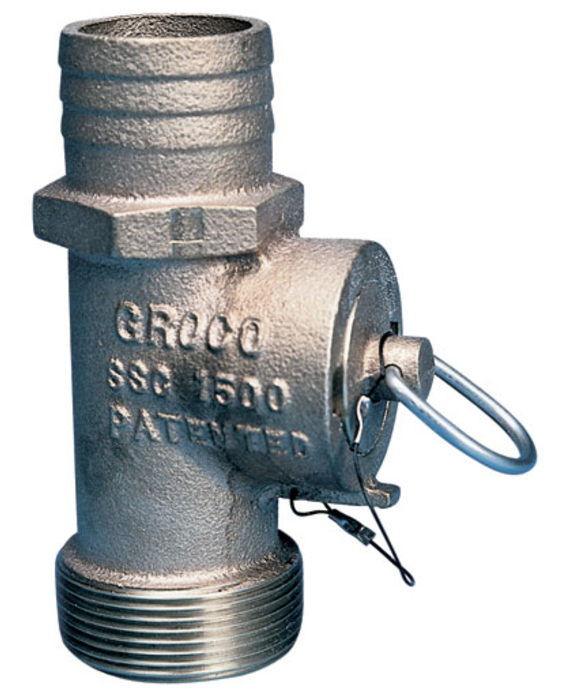 Groco SSC Engine Flush Kit
 Image: Courtesy of Groco
This solution can be formalised by adding a 'Safety Seacock Converter' made by Groco. This adapter can be added to any existing seacock to provide an instant emergency bilge pump. With this fitted, all that is required is to close the seacock whilst the engine is running and removing the quick release plug. Any water above the release plug will be drawn in and pumped overboard by the engine raw water pump. Groco also offers a bilge strainer adapter for bilge locations remote to the seacock.
The fitting also comes with a service adaptor that facilitates winterisation. To use this simply close the seacock, remove the quick release plug and insert the service adaptor with a feed-in of anti-freeze to be pumped into the cooling system or fresh water if it is used to heat the engine oil at idle speed for a service, whilst the vessel is standing on the hard.
With thanks to:
Michael HarpurYacht taking on water
 A photograph is worth a thousand words. We are always looking for bright sunny photographs that illustrate this experience. If you have some images that we could use please upload them here. All we need to know is how you would like to be credited for your work and a brief description of the image if it is not readily apparent. If you would like us to add a hyperlink from the image that goes back to your site please include the desired link and we will be delighted to that for you.
Add your review or comment:
Please log in to leave a review of this tip.
eOceanic makes no guarantee of the validity of this information, you must read our legal page. However, we ask you to help us increase accuracy. If you spot an inaccuracy or an omission on this page please contact us and we will be delighted to rectify it. Don't forget to help us by sharing your own experience.